The centenarian’s toolkit - step 1
A set of the simplest things that are very easy to put in place and give you a really big lever for your health. Maybe except food, because it means logging meals in Fitatu. But hello! In Fitatu Premium you can add food by voice note, and that turns it into fun. Hop on board with me for the trip to a hundred.
No energy to read? Here it is as a podcast, and here as a visual cheat sheet.
01Find your hour
Sleep is number one, and it is non-negotiable. You could write a whole lot about it, but I am picking these three things:
- While you sleep, you don’t work, you don’t reproduce, you don’t compete for a partner, you don’t gather food. And it is extremely dangerous: during that time you are completely defenceless. You do nothing that evolution has rewarded for millions of years: success, survival, safety. And yet, through all those millions of years, sleep has stayed exactly where it was. Every animal studied so far sleeps, even hydras and jellyfish, which have no brain. If such a seemingly maladaptive trait has stayed unchanged for millions of years, then guess what… it is a sign of how hugely adaptive it actually is.Nath et al., 2017, Current Biology · Kanaya et al., 2020, Science Advances
- When we move the clocks forward to summer time in spring and take away just one hour of sleep, there are 24% more heart attacks on the Monday after the change. In autumn, when we get that hour back, there are 21% fewer on the Tuesday after the change. That is ONE hour.Sandhu et al., 2014, Open Heart
- In a large study of more than 60,000 people, sleep regularity predicted the risk of death better than the number of hours slept.Windred et al., 2024, UK Biobank
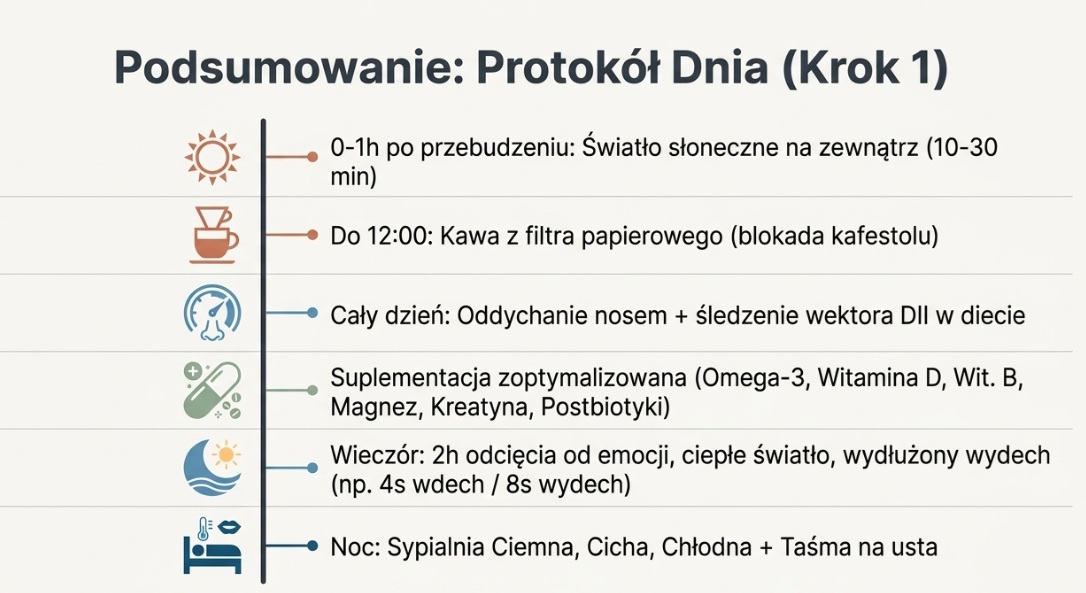
Outdoors in the morning. Daylight soon after waking is the strongest signal for your body clock: it sets the time you will start feeling sleepy in the evening. Even on a cloudy day it is many times brighter outside than in your flat. It is a stronger signal of when you will get sleepy than evening screen time or emotions! Even so…
In the evening, keep light and emotions to a minimum. Blue-light-blocking glasses can help, or special lighting at home, or at least dimming all the lights as much as you can and switching on only the warm ones. For the last 2 hours before bed, minimum emotions: no difficult conversations, no exciting podcasts. Together with the morning light, let those 2 hours before sleep be your sacred time.
Your chronotype is your internal clock, the one your whole body runs on. Almost every cell in the body has “clock” genes that control the timing of everything that happens in the body, so that all of it runs as optimally as possible, so that you don’t get sick and have as much energy as possible. When you disrupt it, you lose that optimisation.
To check your clock, get up without an alarm for a few days off. In the morning spend about 10–30 minutes outdoors within an hour of getting up, and in the evening keep the lighting minimal and warm. Under these conditions your chronotype shows itself, along with the natural time your body wants to wake up and fall asleep on its own. And when you get closer to your natural rhythm, a lot of things sort themselves out.
Every group of cells in the body has its own timing. It is a bit like a factory: first one part rides along the conveyor belt, then it gets painted, then a second part is added, and so on, until at the end you get, say, a car.
The body works the same way. Waking up, digestion, activity, immunity: everything runs on its own clock, and those clocks are linked to each other. The more things we do at similar times, the more we work in step with them. We don’t assemble unpainted parts or a car without wheels.
Maybe it is a naive example, but that is exactly how it works. Almost every cell in the body has clock genes. And in every organ a different share of genes follows a rhythmic, daily pattern of expression (switching on and off in a 24-hour cycle). Counting the whole body, in mice that is almost half of all genes (43%), and in baboons even more than 80%. Among them are genes in heart, liver and muscle cells, but also genes linked to cancer, Alzheimer’s disease, type 2 diabetes, coronary heart disease, schizophrenia and obesity. When we throw this rhythm off, the risk of these diseases goes up or their symptoms get worse. In 2017 the Nobel Prize in Medicine was awarded for research on the body clock.Zhang et al., 2014, PNAS · Mure et al., 2018, Science
How strongly this works is best shown by the story of the French oncologist Francis Lévi. In the 1980s oxaliplatin, a drug for colorectal cancer, was about to be binned because it was too toxic. Lévi knew that healthy cells in the gut and bone marrow divide only at certain times of day, while cancer cells divide around the clock. So he started giving the chemotherapy when the healthy cells were resting: oxaliplatin in the afternoon, the second drug early in the morning, controlled by a special pump. One of the first patients kept phoning him to complain: “You’re fooling me, you gave me a placebo”, because he had no side effects at all. In reality he was getting a much higher dose than usual. Today oxaliplatin is one of the main drugs for advanced bowel cancer. Linda Geddes tells this story in her book “Chasing the Sun”.
02Routines, step by step
Once you tidy up your clock and start living in step with it, it is much easier to add routines, morning and evening ones. Look for them slowly. Choose things that you enjoy on the one hand and, on the other, know will give you something in the long run.
A ritual is nothing more than Pavlov's bell. The dog salivated at the bell because it always came before food. For you, the same set of calm music, a book and dimmed light always comes before sleep, so after a few weeks simply switching them on starts to trigger falling asleep: heart rate drops, drowsiness rises. This is the mechanism behind stimulus control, the oldest and best-studied part of insomnia therapy (CBT-I).
For me the evening routine came first. I started by listening to singing bowls and gongs on Insight Timer and doing short meditations before falling asleep. Later I added reading for an hour or two before bed. Then breathing exercises. The more I can combine, the better. Even my dogs caught the automatism: when I put on the bowls and open a book in bed, they jump up for cuddles.
In a study of 10,000 mothers from 14 countries, a consistent bedtime routine was linked to falling asleep faster, fewer night wakings and longer sleep, and in a dose-dependent way: the more evenings a week with the routine, the better.Mindell et al., 2015, Sleep
In an online RCT with 991 people, after a week of reading a book in bed 42% of participants felt they slept better, compared with 28% in the group without a book.Finucane et al., 2021, Trials
How long does it take? A meta-analysis of 20 studies with 2,601 people: a habit usually forms after about two months, but the range is 4 to 335 days. The habits that stick best are the ones you chose yourself and do in the morning. And in data from 12 million gym visits and 40 million hand washes in hospitals there was no magic number of days: the gym habit took months to form, the handwashing habit weeks. The harder the activity, the longer it takes.Singh et al., 2024, Healthcare · Buyalskaya et al., 2023, PNAS
Six studies, 2,274 people: people with high self-control do not fight temptation any harder. They have habits (sleep, exercise, studying) that do the work for them; habits even accounted for grade point average and staying in college.Galla and Duckworth, 2015, Journal of Personality and Social Psychology
And the scale of this is large. In Dunedin, 1,000 people were followed from birth to age 32: childhood self-control predicted adult health, finances, addictions and criminal records, independently of IQ and social class. In two British cohorts, 16,780 people over 40 years, children with low self-control had 1.6 times as many months of unemployment as adults.Moffitt et al., 2011, PNAS · Daly et al., 2015, Psychological Science
03Breathing with a long exhale
A long exhale switches on the parasympathetic nervous system, the part of the nervous system responsible for rest, digestion, calm, stress relief and recovery. I do breathing exercises mostly in bed, before sleep. But they also work really well as a reset during the day, under heavy stress.
There are many ways to do calming breathing exercises. Find one that suits you:
- Box breathing: breathe in for 4 seconds, hold for 4 seconds, breathe out for 4 seconds, hold for 4 seconds.
- Long exhale: breathe in for 4 seconds, breathe out for 6–8 seconds.
- My latest version: breathe in for 4 seconds, hold for 4 or longer, breathe out for 8 or longer and straight away a calm breath in for 4.
- The exhale does the work. With every inhale your heart speeds up slightly, and with every exhale it slows down, because that is when the vagus nerve puts the brakes on its rhythm. Try it: put your fingers on the pulse at your wrist and do a slow, long exhale. You will feel the beats stretching out. The longer the exhale, the longer the heart runs at lower revs. When people in an experiment breathed at the same pace, once with a long and once with a short exhale, with the long one the body was clearly more in rest mode and they felt calmer.Yasuma and Hayano, 2004, Chest · Van Diest et al., 2014, Applied Psychophysiology and Biofeedback
- It works straight away and over time. In a meta-analysis of 223 studies, slow breathing raised HRV during the exercise, right after a single session and after several weeks of regular practice.Laborde et al., 2022, Neuroscience & Biobehavioral Reviews
- Less stress and fewer depressive symptoms. In a meta-analysis of randomised controlled trials (RCTs), breathing exercises lowered stress (12 RCTs), anxiety (20 RCTs) and depressive symptoms (18 RCTs). The effect is moderate but consistent, and the exercise costs nothing and has no side effects.Fincham et al., 2023, Scientific Reports
04Breathing through your nose (day + night)
The nose is for breathing; the mouth is for eating and talking. The nose filters the air, warms it and moistens it, and from the sinuses it adds nitric oxide to every breath, which widens the blood vessels in the lungs, so we take up almost 20% more oxygen than when breathing through the mouth. When the mouth becomes your everyday way of breathing, the airways weaken and narrow, we sleep worse, snore more and get ill more often. Mouth breathing is an important cause of tooth decay, and by changing the shape of the face it leads to bite problems. Sleeping with habitual mouth breathing raises blood pressure and heart rate, lowers HRV and worsens mental performance and well-being as a result of low oxygen, including low oxygen in the brain.
At night I sleep with tape on my mouth. It makes sure I breathe through my nose. Even if I breathe through my mouth only 5% of the time, that is 5% of my health made worse. Putting on the tape costs nothing, and after a while you can no longer part with it. It is also worth checking first how much of the night you breathe through your mouth, snore or have apnoeas, by running the SnoreLab app overnight.
During the day I also make sure I breathe through my nose. And especially when I exercise.
Humans are the only mammals that suffer from misaligned dental arches. The phenomenon of Homo sapiens is a brain that developed faster than in any other animal species. The price was that the brain took over space in the skull where the sinuses, the mouth and the airways used to be. The mouth got smaller and moved back. The bigger the brain grew, the tighter the airways became. A few other changes came along: the larynx dropped lower, the tongue became more agile, and we are the only ones who can choke. And although the brain and speech were behind our ultra-fast development, they made breathing harder for us.
Today 40% of people suffer from chronic nasal obstruction, and about half habitually breathe through the mouth. 45% of adults snore occasionally, and 25% snore all the time. Obstruction lets bacteria grow, and they increase disease and make the obstruction worse.
More mouth breathing means less pressure in the airways. These already narrow airways “don’t train”, so they lose their firmness and collapse. That makes breathing even harder… and leads to even more mouth breathing. The facial skeleton remodels: it narrows and drops down, the teeth no longer fit, hence bite problems. In inhumane experiments on monkeys whose noses were blocked for a year, the face grew downwards and the dental arches narrowed.
And on the other hand (and this is just one of many remarkable examples): during experiments with elite athletes, Dr John Douillard had them breathe once only through the mouth and once only through the nose while cycling, with the load rising every few minutes up to 200 watts. In the mouth version, by the end of the experiment the athletes were fighting for every breath. In the nose version, their breathing rate in the hardest phase of the exercise went down! It dropped from 47 to 14 breaths a minute, and their heart rate stayed the same despite a tenfold increase in load.
Breathing through the nose alone can raise nitric oxide levels sixfold, which is one of the reasons we take up 18% more oxygen than when breathing through the mouth.James Nestor, “Breath”
05Bedroom: dark, quiet, cool
Just like sleep regularity and sleep length, this is the basics of the basics. Especially after forty: between the ages of 20 and 50, the share of deep (slow-wave) sleep in men drops from about 19% to about 3% of the night, replaced by lighter sleep that is easier to wake from. Less deep sleep means light, sound and heat break your sleep more easily than they did when you were young.Van Cauter et al., 2000, JAMA: 149 healthy men aged 16–83
Cool. Falling asleep requires the core body temperature to drop by a few tenths of a degree. The body does this by widening the blood vessels in the hands and feet and shedding heat through them. The speed of that widening is the best known predictor of how fast you will fall asleep. A warm room blocks the heat loss, and with it the whole mechanism.Kräuchi et al., 1999, Nature
Dark. The retina has a separate type of cell (containing melanopsin) that is not for seeing: it measures brightness and reports it to the clock in the hypothalamus. These cells work through closed eyelids too. Ordinary room light in the evening shortens the night's melatonin release by about 90 minutes, and light switched on during the night suppresses it by more than half.Gooley et al., 2011, Journal of Clinical Endocrinology & Metabolism: 116 healthy people
Quiet. Hearing does not switch off during sleep. The thalamus (the brain's relay station) keeps passing sounds on, and the cortex answers every louder one with a so-called K-complex, a brief "check". Noise does not have to wake you to do harm: the sounds of aircraft, trains and cars at night raised sleepers' heart rate by about 9 beats per minute even when the EEG showed no sign of waking, and the heart did not get used to them by morning. This is called an autonomic arousal. You do not remember it in the morning, but your heart has worked through the night.Griefahn et al., 2008, Sleep: a sleep-lab study
One night with a dim light on in the room (100 lux) is enough. In healthy adults the heart beat faster during the night, heart rate variability (HRV) dropped, and insulin resistance rose the next morning, compared with a night in almost complete darkness.Mason et al., 2022, PNAS: a sleep-lab study
Noise works the same way. Healthy adults slept in their own homes while a speaker played 30 or 60 aircraft flyovers per night. In the morning their blood vessels widened less well (worse endothelial function, the endothelium being the lining of the vessels) and there was more adrenaline in their blood than after a quiet night. Importantly, the effect grew with the number of flyovers and disappeared after a dose of vitamin C, which points to oxidative stress.Schmidt et al., 2013, European Heart Journal: 75 healthy people, a study in their homes
In wristband data from 47,000 people in 68 countries, nights above 25°C raised the odds of sleeping less than 7 hours, and nights above 30°C cut sleep by about a quarter of an hour on average. Older people and residents of warm countries suffered most, that is the ones who in theory should be used to it.Minor et al., 2022, One Earth: 7 million nights
06Coffee before noon and through a paper filter
Caffeine can stay in your blood for as long as 10 hours after you drink it. With age, sleep becomes more sensitive to it, so here I am winking at everyone 40+. Coffee drunk in the afternoon or evening can make your sleep shallower, even if you fall asleep without any trouble.Robillard et al., 2015, Journal of Psychopharmacology
Coffee oil contains cafestol, a compound that raises “bad” LDL cholesterol. A paper filter holds back almost all of it.
The most cafestol is in French-press, Turkish and boiled coffee. Espresso has less, but with a few a day it adds up too.
07Supplements
This is a very long story (because everyone has different deficiencies, does or doesn’t do check-up tests, is on a different diet and so on), but here we will simplify it as much as possible, to get closer to “everyone should supplement this”. Especially every longevity freak.
- Omega-3 is god :) It affects the body in many ways, and the most important are: damping down inflammation, supporting memory and attention, lowering oxidative stress (in simple terms – ageing). It eases pain and improves mobility in osteoarthritis. It is worth investing in a good one and taking higher doses (3–4 g). If you take anticoagulants, discuss higher doses with your doctor.
- Vitamin D – god no. 2 🙂 And most Poles are deficient. It modulates the processes of cellular ageing, including switching off chronic inflammation, improving mitochondrial function and gene stability. It is pleiotropic, which means it acts in almost every tissue of the body. It is the absolute foundation of strong bones, immunity, neuromuscular performance and reducing depression.
- B vitamins. In short, you can think of them as “brain, nervous system, gut, microbiota”. They play key roles in energy metabolism, DNA/RNA synthesis, methylation, blood formation, nervous system function, immunity and gut homeostasis, and cell signalling. Their actions are closely interdependent, so a deficiency in one can disrupt many pathways at once.
- Magnesium. Because deficiency symptoms are so common and so widespread (30–50% of adults in developed countries), supplementing makes sense for most people. You probably know these symptoms – muscle cramps (especially in the calves, at night), eyelid twitching, trouble falling asleep, irritability and anxiety, brain fog, fatigue, heart rhythm disturbances, lower stress tolerance. If you want to test your level, test red blood cell (erythrocyte) magnesium, because it is much more accurate than serum magnesium.
- Creatine. The best-researched sports supplement and one of the most effective. A longevity-kit classic. It increases muscle strength, speeds up recovery and supports cognitive function. Athletes, older people and anyone under physical or mental overload benefit from it most.
- Immunaxis by Koenza: a liquid postbiotic made from fermented blueberries and black raspberries with elderberry extract. I take it to improve my gut microbiota. It is my discovery of the year. In my case it has worked wonders. And that is not an exaggeration in the slightest. My Koenza story (in Polish) →
To understand why sorting out your gut can change sleep, immunity and mood all at once, you have to go back 600 million years. The first animals, such as hydras, were basically a floating digestive tube wrapped in a nerve net. The gut and the nervous system were one organ. Microbes moved in around 500 million years ago, and since then these three – gut, nerves and bacteria – have evolved together. The brain appeared much later and took over a ready-made language of signalling molecules from the gut. That is why the gut is called the “second brain”, even though historically it came first.
To this day the gut has its own nervous system, its own hormonal system (the cells in its wall together make up the largest endocrine organ in the body) and its own immune system. Thick bundles of nerves, above all the vagus nerve, connect it to the brain, and signals travel both ways: from the gut to the brain and back. This conversation regulates not only hunger and fullness, but also mood and well-being.
Now immunity. According to Mayer, about 70% of the body’s immune cells sit in the gut wall. That is no accident: the gut is the largest surface of contact with the outside world, with food and with trillions of bacteria. Only a thin layer of mucus separates the immune cells from those bacteria. Some of them, dendritic cells, push “tentacles” into this mucus and keep checking what is on the other side. When they don’t like something, they send out cytokines, the signalling molecules of inflammation. And from the gut, cytokines travel with the blood to every organ: to the heart, the liver, fat tissue and the brain.
And this is where the trouble starts. When food is low in fibre and high in sugar, fat, emulsifiers, sweeteners and preservatives, the bacteria go hungry. Then they start eating what they have to hand – the protective mucus, because it is built from sugar-like molecules. The layer gets thinner, bacteria come into contact with immune cells, and these react the only way they know: with inflammation. Not the acute kind, like during an infection, but a low-grade, chronic one that never goes out. Mayer calls it metabolic endotoxaemia and sees it as the common denominator of the diseases of civilisation: obesity, diabetes, heart disease, autoimmune diseases, and also mood and cognitive disorders, because inflammatory mediators reach the brain.
The most interesting discovery of recent years is that what matters is not which bacteria you have, but what they produce. Healthy people in developed countries share only about 10% of their bacterial strains. Yet very different bacterial communities can make similar sets of metabolites and signalling molecules, and it is these molecules that talk to the gut, the immune system and the brain. A postbiotic like Koenza is exactly that: not live bacteria, but the finished products of their work.
And finally, something that ties this article together. The microbiome has a daily rhythm too. Communication between the clock in the brain and the gut runs both ways, and irregular sleep and meal times throw bacteria off just as they throw us off. When Christoph Thaiss of the Weizmann Institute gave mice antibiotics and flattened the daily swings of their microbiome, the bacteria started producing molecules that passed into the blood and changed how the liver and brain worked. In humans, similar disruption shows up after crossing time zones. That is why this text starts with the chronotype: the clock, the gut, immunity and the brain are one network, not four separate topics.
Based on: Emeran Mayer, “The Gut-Immune Connection”, chapters 1–308Keeping an eye on your diet
With an app that pulls data from Fitatu and sums up your nutrition progress, you have an ongoing view of how well you are sticking to your diet. And we know (we do know, right?) that diet, together with sleep and movement, is the holy trinity of longevity and health.
I log my meals in Fitatu, and my app works out three things from them: how keto I ate (for me), how anti-inflammatory, and how simply healthy – based on established indices of dietary inflammation and diet quality (DII and AHEI).
A view like this makes it much easier to become aware of how simple tweaks, such as matcha, spices or tea, can easily make your diet more anti-inflammatory.
I don’t count every gram. I look at whether the overall direction is right.
The fuller the ring, the better. Inflammation is the Dietary Inflammatory Index (DII): minus means anti-inflammatory, plus means pro-inflammatory.
The app is still in testing. Early access opens soon. If you want to be among the first, leave your email – it takes half a minute.
I want early access →Movement, relationships, treatment, neuroarchitecture (how the space around you affects the brain) and gratitude.
This is my own kit, not medical advice. If you have a chronic condition or take medication, discuss any changes with your doctor.